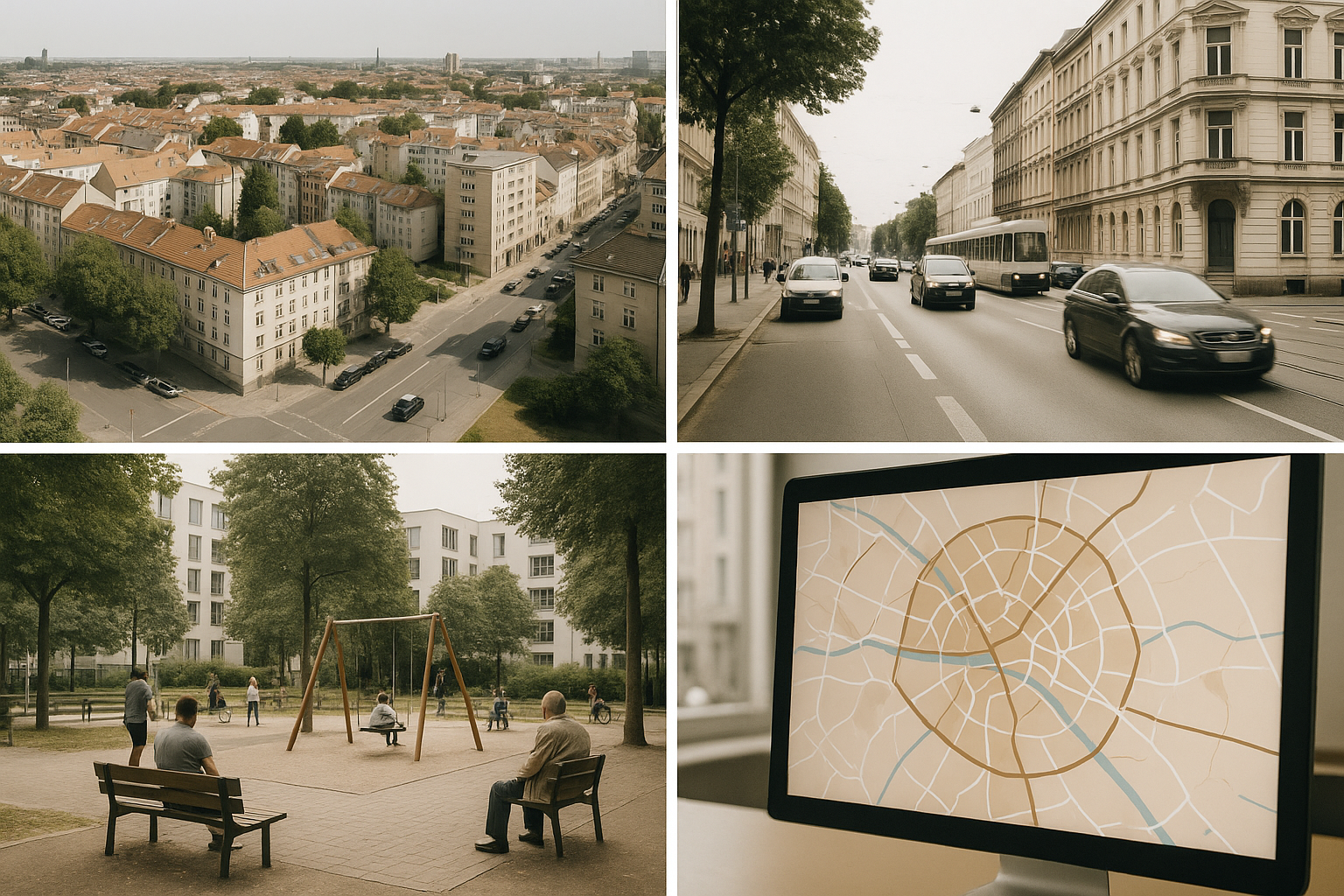
Villaverde sits in the southern reaches of Madrid, separated from the city’s prosperous north by more than geography. It is one of the capital’s most densely populated districts and one of its most socioeconomically deprived. Premature mortality from cardiovascular disease here is significantly higher than the Madrid average — following the socioeconomic gradient in cardiovascular mortality documented across Spanish cities, and hospitalisation rates for heart failure and ischaemic heart disease follow the same gradient.
These numbers reflect a pattern visible across European cities. Cardiovascular risk does not distribute itself randomly. It concentrates where poverty concentrates, where housing quality is lowest, where access to green space is most limited, and where the density of health-damaging retail — tobacco, alcohol, fast food — is highest.
What a Community Health Centre Does Differently
The CMSc Villaverde — Centro Madrid Salud comunitaria — is designed around a different model from the standard primary care clinic. Rather than functioning primarily as a site for diagnosing and treating individual patients who present with symptoms, it operates as a community resource focused on prevention, health promotion, and the social determinants of health.
In practice, this means working at the neighbourhood level rather than the individual level. The centre engages with local associations, schools, and community groups. It runs health literacy programmes. It provides a physical space where residents can access information, social support, and services without the barrier of a formal medical appointment. It takes as its starting point the understanding that many of the factors driving cardiovascular risk in Villaverde are environmental and social rather than purely individual.
Proximity and Trust
Research on community health infrastructure consistently identifies two factors that make neighbourhood-based health resources effective: proximity and trust. Both are more significant than they might appear.
Proximity matters not simply because it reduces travel time, but because it changes the nature of engagement with health services. A resource embedded in the community — physically present, known, associated with familiar faces — lowers the threshold for contact. People who would not seek out a hospital or a specialist will use a nearby community health space for information, a conversation, or a referral.
Trust is harder to build and harder to measure. In communities with histories of institutional neglect, trust in formal health services tends to be lower, and the consequences are visible in health outcomes. Community health centres, when they function well, build trust by demonstrating consistency, responsiveness, and genuine engagement with the concerns of the population they serve.
The Evidence for Community Health Models
The evidence for community health centre effectiveness in reducing cardiovascular risk is strongest in the area of preventive care. Studies from comparable models in the UK, Spain, and the Netherlands consistently find higher rates of blood pressure screening, higher uptake of smoking cessation support, and better management of cardiovascular risk factors among populations served by community health resources compared to those accessing only traditional primary care.
A 2020 review in the Journal of Urban Health examining community health centre models across European cities found that proximity to a community health resource was independently associated with reduced emergency department utilisation for cardiovascular events — suggesting that the centres were successfully managing risk before it became acute.
What Villaverde Tells Us About Urban Health Policy
The CMSc Villaverde model is not a solution to the structural conditions that make the district’s cardiovascular outcomes worse than Madrid’s richer areas. It cannot fix housing quality, poverty, or the neighbourhood-level factors that drive chronic stress. What it can do is provide consistent, trusted, accessible support that reduces the cardiovascular burden at the margins — and those margins matter enormously when talking about premature death.
More broadly, it illustrates a principle that has gained traction in European public health policy: that the geography of healthcare provision matters, not just the overall level of provision. Distributing health resources in proportion to need — rather than in proportion to existing wealth and infrastructure — is a precondition for addressing the cardiovascular inequalities that are so visibly written into the maps of every major European city. Villaverde is an imperfect, underfunded case study — and one whose neighbourhood environment has been documented in detail through photovoice research involving residents themselves in what that principle looks like in practice. And it represents a model worth taking seriously.